

“Me refiero a los objetos como lugares de descanso para la vida porque estabilizan la vida humana. La misma silla y la misma mesa, en su semejanza, prestan cierta estabilidad y continuidad a la voluble vida humana.
Podemos demorarnos con los objetos. Con información, sin embargo, no podemos.”
Byung-Chul Han
Realidades Plegables
Una obra en progreso realizada por una obra en progreso:
Leanne Bock
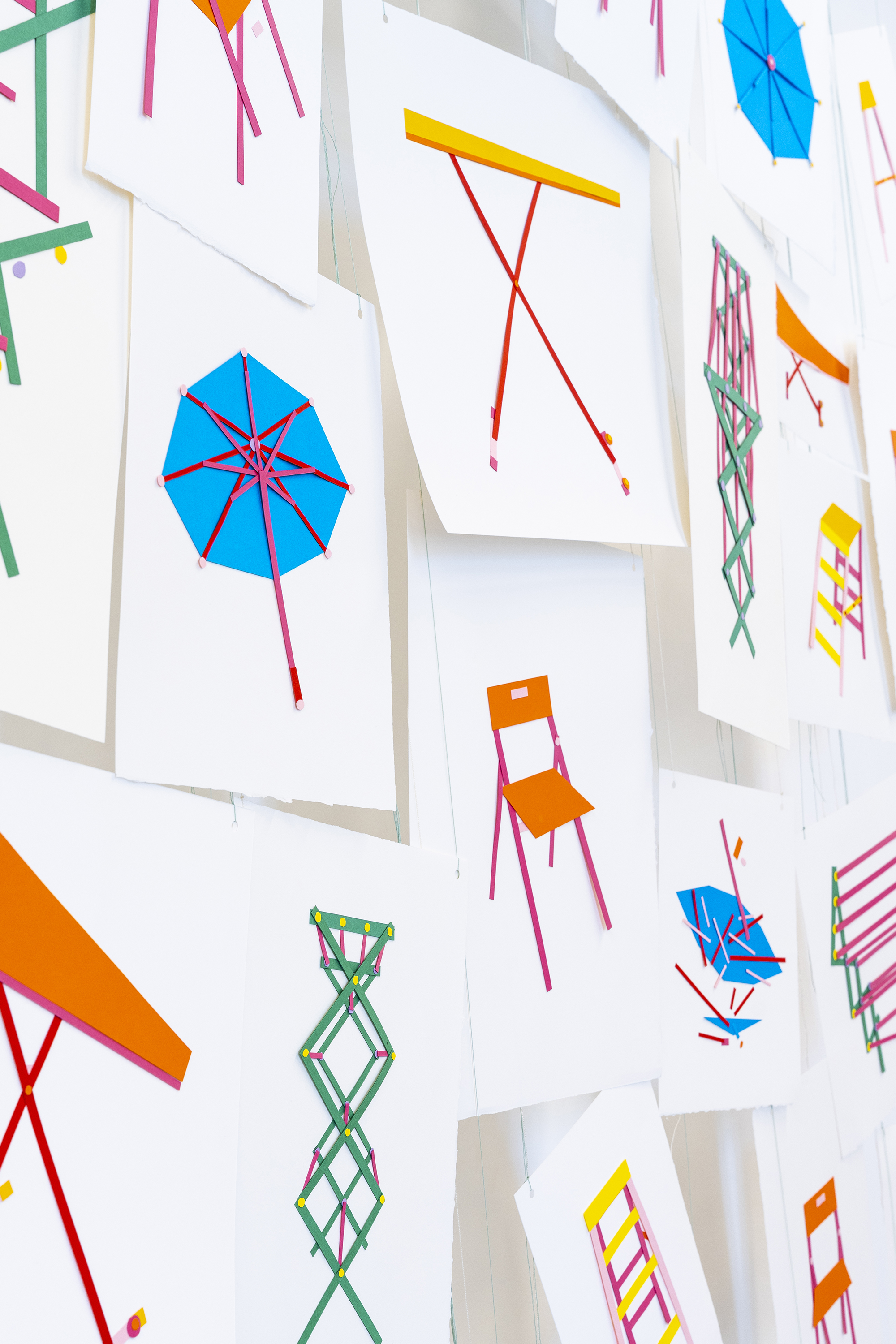
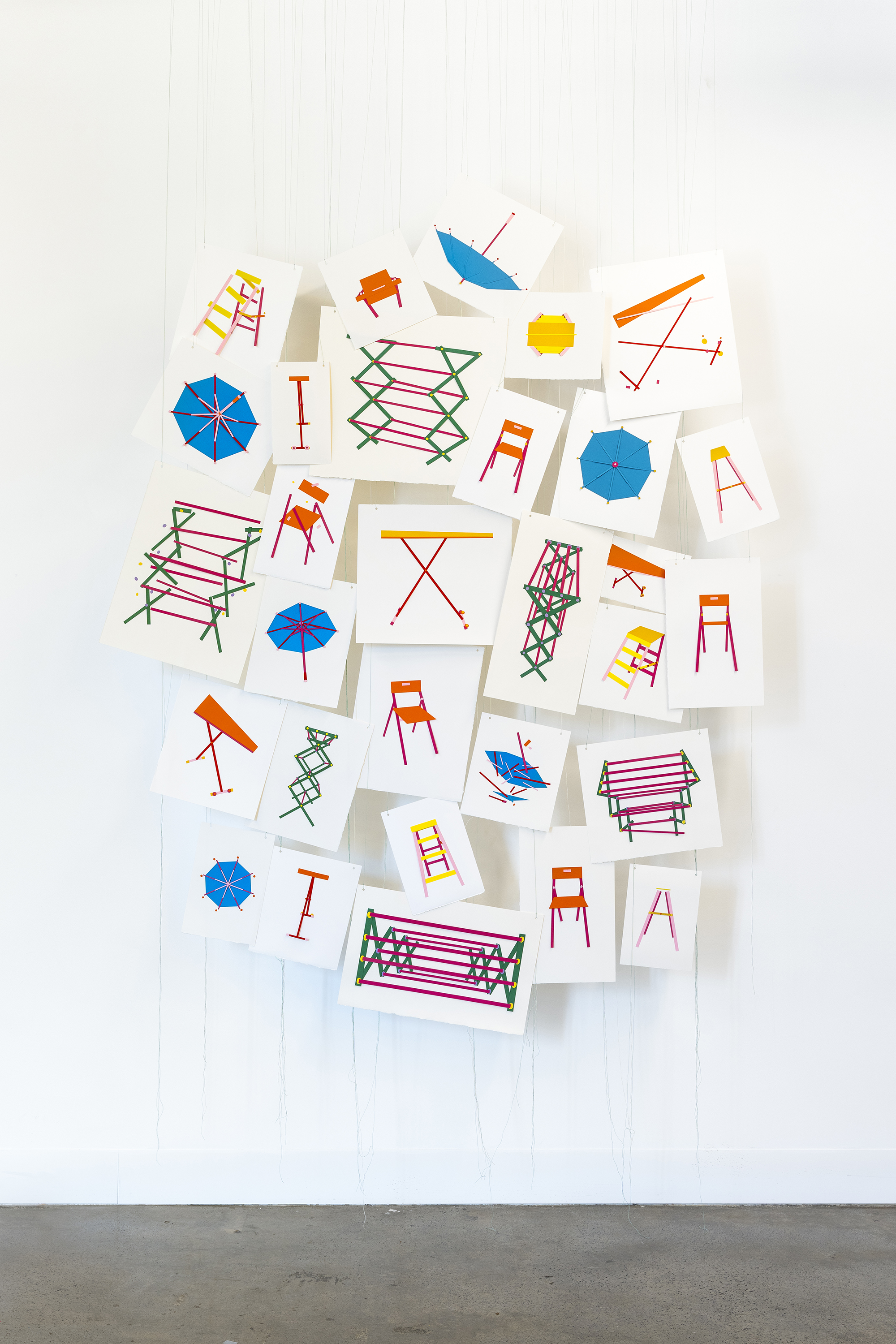
Trabajo con objetos cotidianos para explorar realidades personales y colectivas a través de alegorías lúdicas. ‘Le Lendemain’ ha sido un proceso experimental de (re)creación por medio de la recreación, desconectándome
de las realidades virtuales para interactuar con lo tangible.
Los objetos cotidianos son familiares, democráticos, inmediatamente reconocibles, concretos, utilitarios, aunque generalmente pasados por alto, y conductos ideales a través de los cuales se puede investigar realidades existenciales, construir lenguajes visuales coloquiales y plantear preguntas abstractas.
¡Los objetos cotidianos plegables, en este sentido, son de otro nivel! Exudan confianza existencial con su propósito sólido, con su identidad estable y su libertad para moverse. No sólo son funcionales, atractivos, livianos, portátiles, fáciles de usar y ordenados, sino que también son socialmente expertos en fluir sin esfuerzo dentro y fuera de la realidad: estando presente cuando sea necesario y casi invisibles cuando no lo sea, desapareciendo graciosamente. Me divierte y luego inmediatamente me perturba, cuando me doy cuenta de que puedo identificarme con haber aspirado encajar en esa descripción, la de un objeto inanimado, y reflexiono sobre las fuerzas sistémicas más amplias que programan socialmente a ciertos individuos y grupos a plegarse y desvanecerse.
Aquí, sin embargo, observo los objetos en su estado activo y desplegado: ocupando un espacio con orgullo, ensamblados triunfalmente con el pecho y la barbilla en alto, listos para cumplir el propósito para el que nacieron (pero, como ya sabes, con el potencial de colapsar dramáticamente, o peor aún, acabar en un desmadre espectacular).
El proceso consiste en trabajar alegremente con las manos, cortando y pegando como si fuera un niño, sin medir ni perfeccionar, formando ensamblajes con materiales y parámetros básicos. Este juego táctil, con la coordinación mano-ojo enfoca la intención y la atención, mientras activa el instinto encarnado y el procesamiento subconsciente. A medida que interpreto las relaciones entre mi punto de vista y mi percepción, entre el color y la forma, y entre el objeto y la realidad, inevitablemente surgen paralelos y proyecciones más abstractas. Poco a poco voy juntando las piezas de forma improvisada.
Intento conocer profundamente la fenomenología de estos objetos, haciendo retratos desde diferentes perspectivas. (Pero al final, en realidad solo son retratos geométricos de uno mismo. No importa dónde me mude geográficamente, no puedo escapar de mi piel ni de las condiciones de mi mirada).
Este sencillo ejercicio, repetido quietamente durante dos semanas, da como resultado una colectiva simplista de perspectivas ligeras y traducciones torpes, que son marionetas de la realidad, apuntaladas por pensamientos interconectados y preguntas invisibles...
¿Qué tan plegables son nuestras realidades
e identidades hoy?
¿Se está expandiendo, desconectando, desvaneciendo o plegando la capacidad colectiva para captar las perspectivas contrastantes?
¿Cuáles son las consecuencias del consumo constante de información desechable y de las perspectivas desencarnadas?
¿Cómo describirías tu identidad sin referirte a un estado
de acción?
¿Cuáles son tus puntos de anclaje existencial?
Textos Relacionados
Oda a las Cosas – Pablo Neruda (Poema, 1959)
Byung-Chul Han: “El mundo se está volviendo menos tangible, más nublado y más fantasmal.” (Entrevista, 2023)
Los objetos nos llaman – Juan José Millás (Libro, 2008)
Comfort Zone – Maddy Weavers (Ensayo, 2023)
El Zahir y El Aleph – Jorge Luis Borges (Cuento, 1949)
Final del Juego – Julio Cortázar (Cuento y Libro, 1956)
Blind Men and an Elephant (Parábola, del antiguo subcontinente de La India)
Nietzsche’s Philosophy of Play – Lawrence M. Hinman (Ensayo, 1974)
The Smooth Spaces of Play: Deleuze and the Emancipative Potential of Games – Tauel Harper (Ensayo, 2009)
“I refer to objects as resting places for life because they stabilise human life.
The same chair and the same table, in their sameness, lend the fickle human life some stability and continuity.
We can linger with objects. With information, however, we cannot.”
Byung-Chul Han
Collapsible Realities
A work in progress by a work in progress
Leanne Bock
Working with everyday objects, I explore personal and collective realities through playful allegories. ‘Le Lendemain’ has been an experimental process of re-creating through recreation, disengaging from virtual realities to engage with the tangible.
Everyday objects are familiar, democratic, immediately recognisable, concrete, utilitarian, yet generally overlooked, and ideal conduits through which to investigate existential realities, to build colloquial visual languages and pose abstract questions.
Collapsible everyday objects, in this sense, are next level! They exude existential confidence with their rock-solid purpose, stable identity and freedom to move. Not only functional, attractive, lightweight, portable, easy-breezy, neat and tidy, they’re socially adept at flowing effortlessly in and out of reality: being there when needed and almost invisible when they’re not, graciously vanishing. Amused, then immediately disturbed, I realise I can relate, and have aspired to fit that description, that of an inanimate object, and reflect on broader systemic forces and social programming influencing the folding-away those who don’t fit the factory default.
Here though, the objects are observed in their active, engaged state: proudly taking up space, triumphantly assembled, chests up, chins high, ready to serve the purpose they were born for (but as we all know, with the potential to dramatically collapse, or worse, reverse into some kind of untameable shitshow).
The process involves working with my hands through simple cut-and-paste child’s play, without measuring or perfecting, making assemblages using basic materials and parameters. This tactile hand-eye coordination focuses intention and attention, engages embodied instinct and activates subconscious processing. As I interpret relationships between vantage point and perception, colour and form, object and reality, more abstract parallels and projections inevitably emerge. Slowly piecing together in a makeshift way.
I try to get thoroughly phenomenologically acquainted with these objects, making portraits from different perspectives. (But in the end, they’re really just geometric portraits of myself. No matter where I move geographically, I can’t escape my skin or the conditions of my gaze).
This straightforward exercise, repeated quietly for two weeks results in a simplistic collective of lightweight perspectives and clumsy mistranslations, puppeting reality, underpinned by interconnected thoughts and invisible questions…
How collapsible are our realities and identities today?
Is the collective ability to grasp contrasting viewpoints expanding, disconnecting, folding away or collapsing?
What are the consequences of continuously consuming disposable information and disembodied perspectives?
How would you describe your identity without
referring to an active doing state?
What are your existential anchor points?
Related material
Oda a las Cosas – Pablo Neruda (Poem, 1959)
Byung-Chul Han: “I Practise Philosophy as Art” (Interview, 2021)
Los objetos nos llaman – Juan José Millás (Book, 2008)
Comfort Zone – Maddy Weavers (Essay, 2023)
El Zahir and El Aleph – Jorge Luis Borges (Short stories, 1949)
Final del Juego – Julio Cortázar (Short story and book, 1956)
Blind Men and an Elephant (Parable, from the ancient Indian subcontinent)
Nietzsche’s Philosophy of Play – Lawrence M. Hinman (Essay, 1974)
The Smooth Spaces of Play: Deleuze and the Emancipative Potential of Games – Tauel Harper (Essay, 2009)